
$80 Million iRev For 2025
Supported accurate charging location data for fuel credit reporting and helped sites launch faster for public use.
An end-to-end installer workflow to help Tesla Energy launch charging sites faster
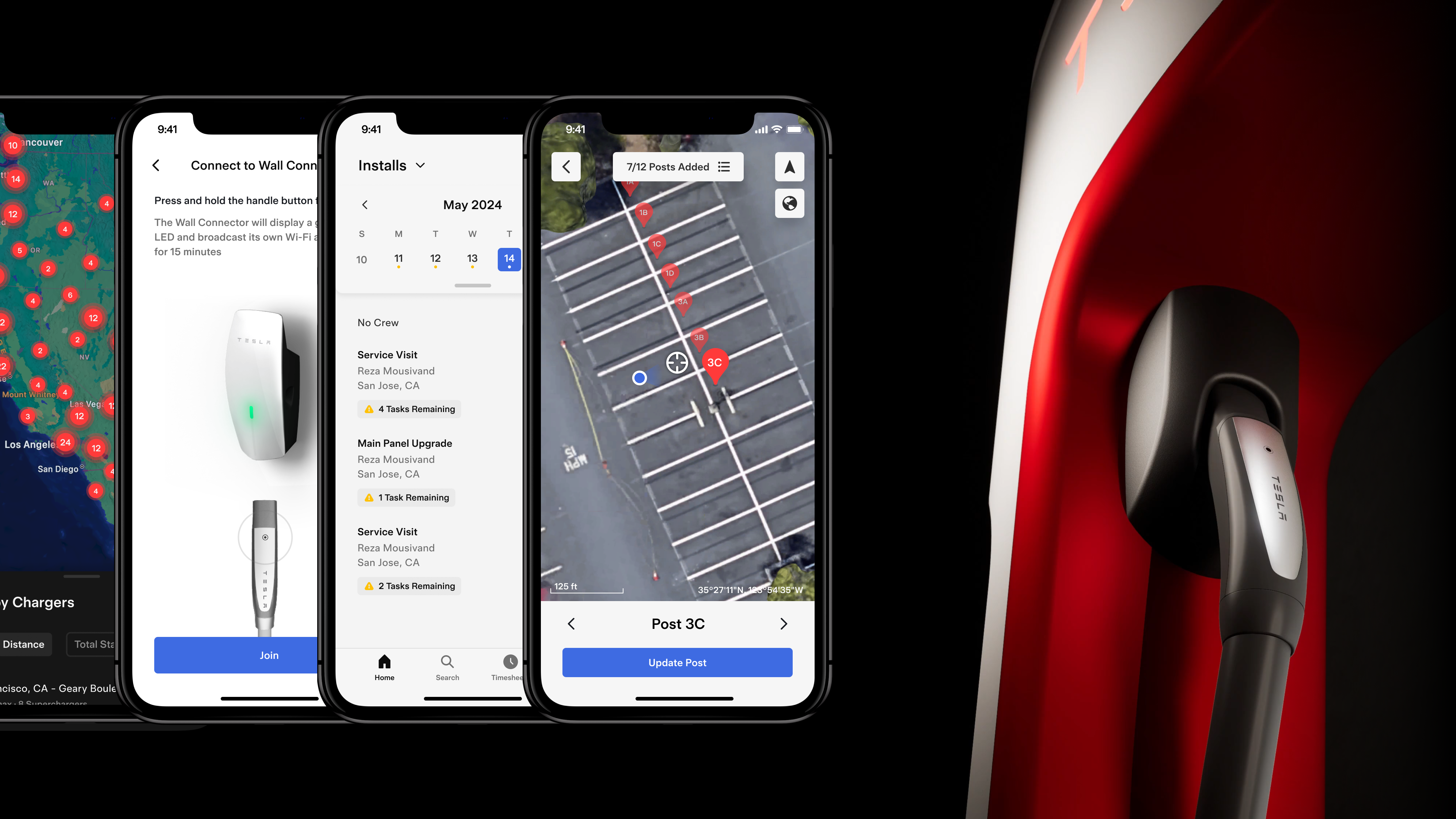
Outcome
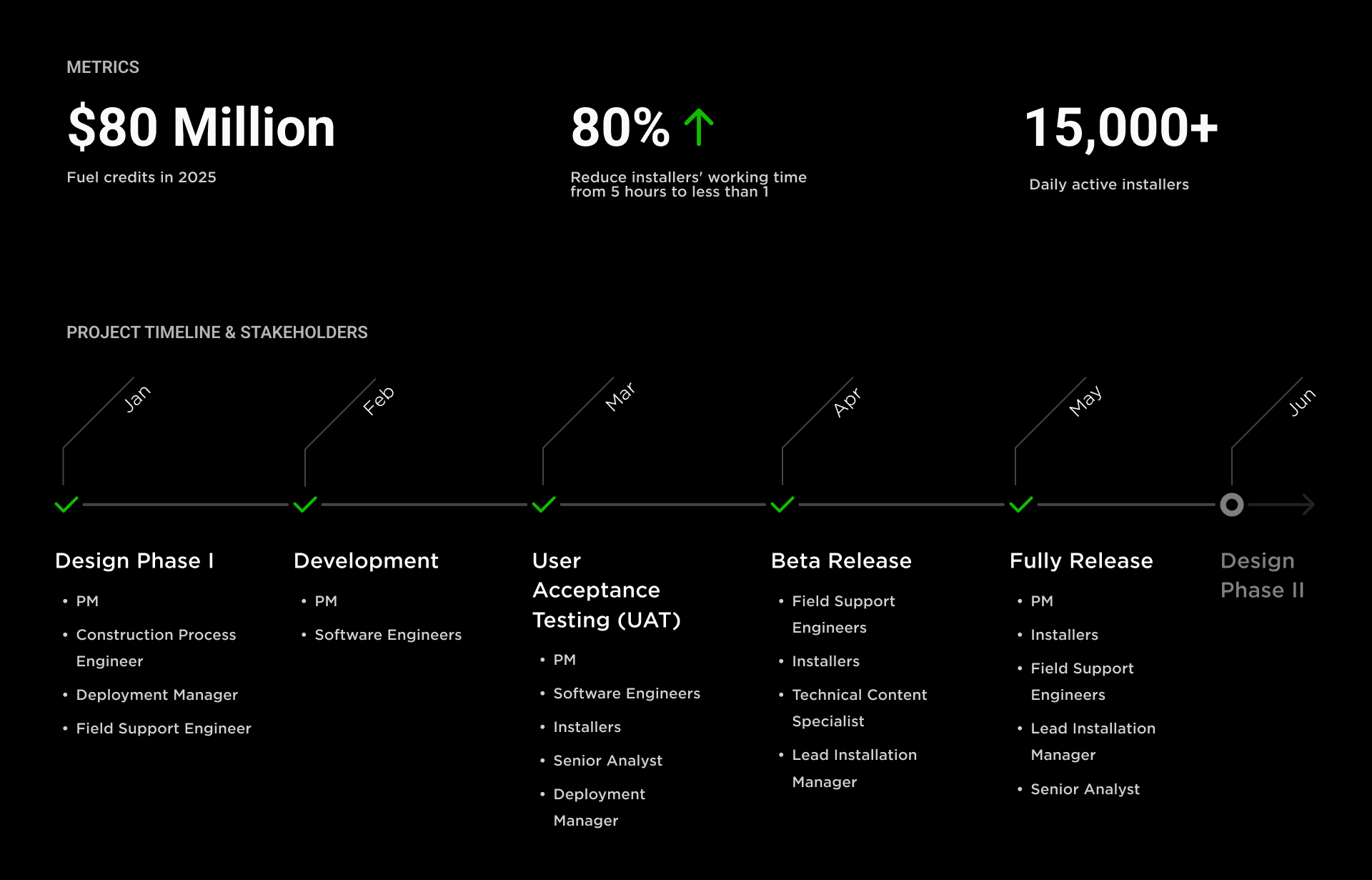
$80 Million iRev For 2025
Supported accurate charging location data for fuel credit reporting and helped sites launch faster for public use.
80% Efficiency Improvement
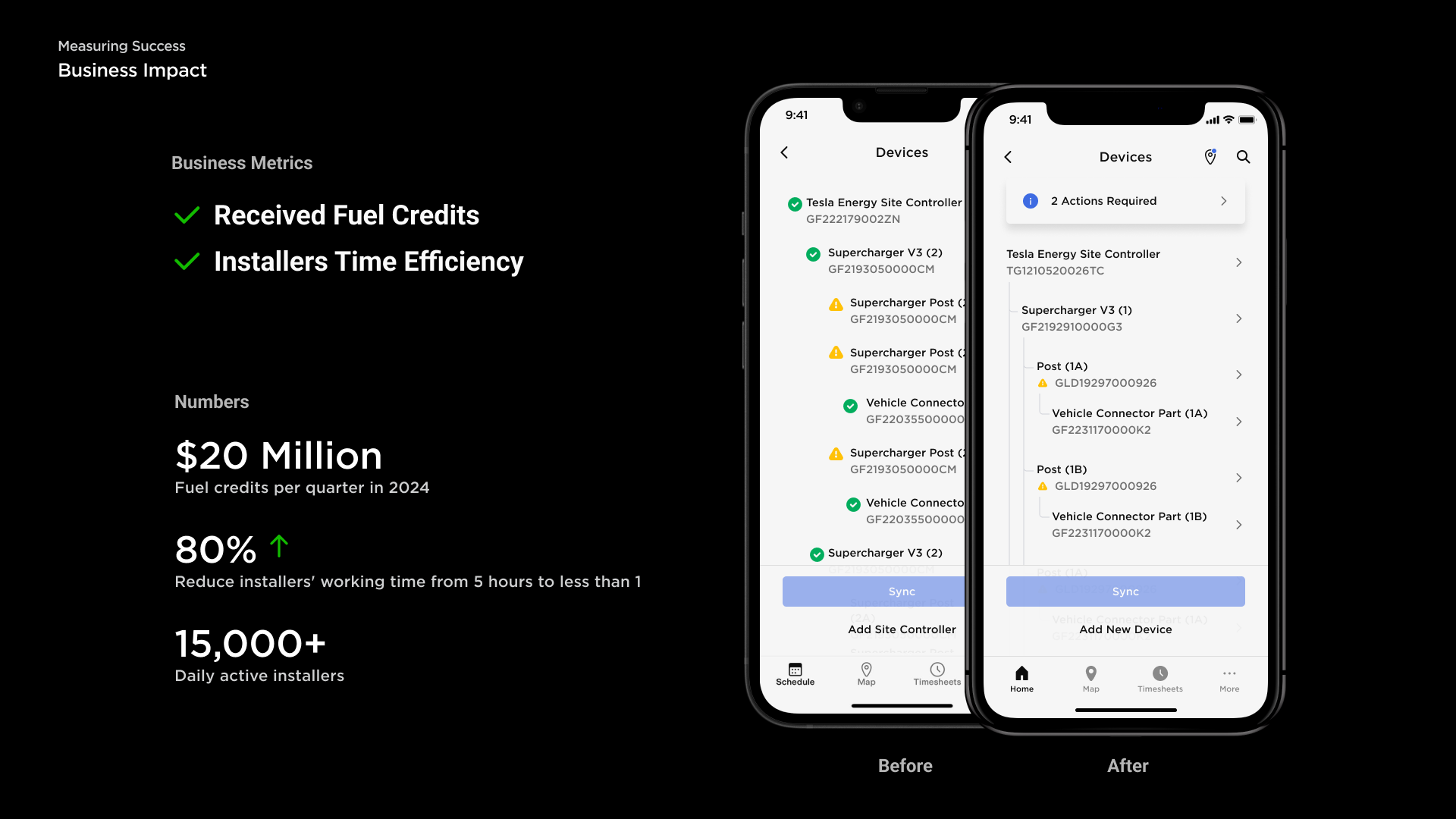
Reduced installer working time from around 5 hours to less than 1 hour during beta, stabilizing around 75%-80% after broader release.
15K+ Daily Users Supported
Released into Tesla One Installs for installers (NENA, APAC & EMEA) working in the field.
Context
What is Tesla One Installs
Tesla One Installs is a field operations platform used by Tesla employees, certified installers, and installation partners to prepare, install, and commission Tesla Energy products.
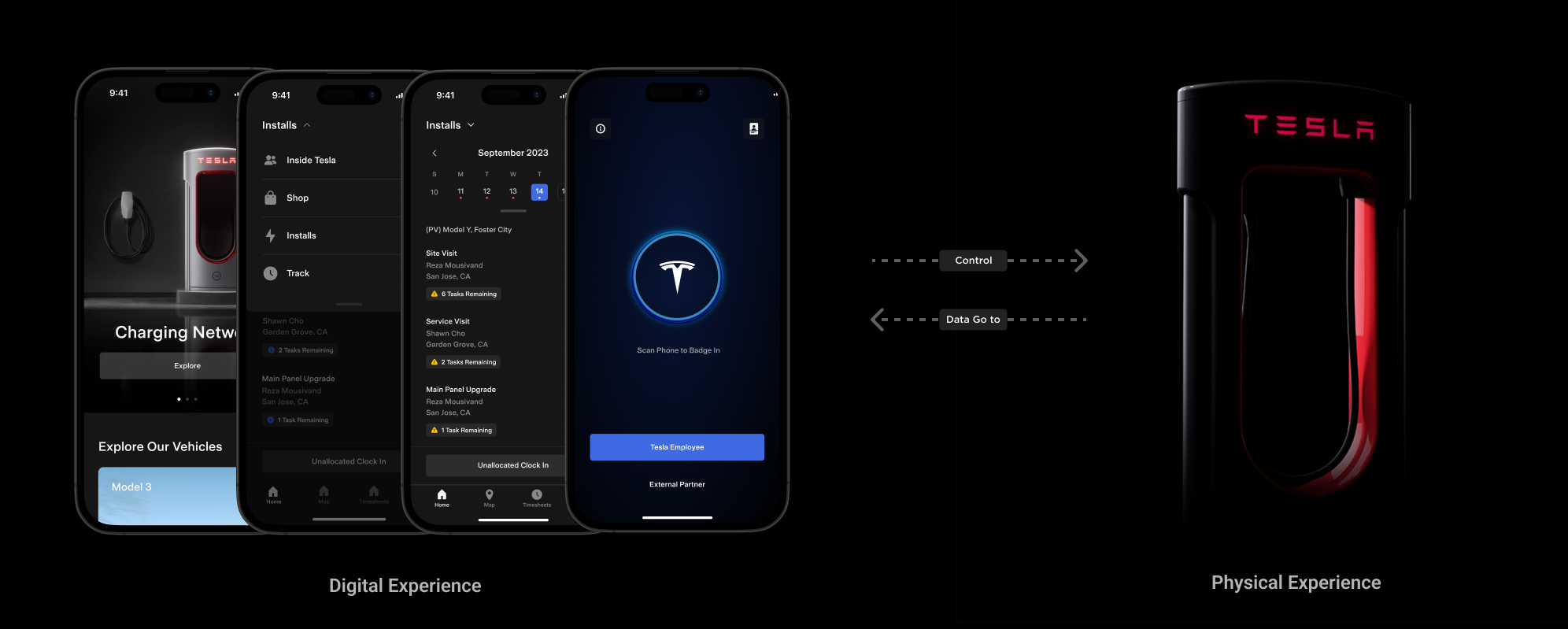
Unlike traditional software products, Tesla One operates at the intersection of physical infrastructure and digital workflows. Installers move through parking lots, charging sites, and equipment locations while continuously interacting with the system to verify devices, update site information, and complete commissioning tasks.
Why the Physical and Digital Workflow Matters
The installation process does not happen entirely on a screen.
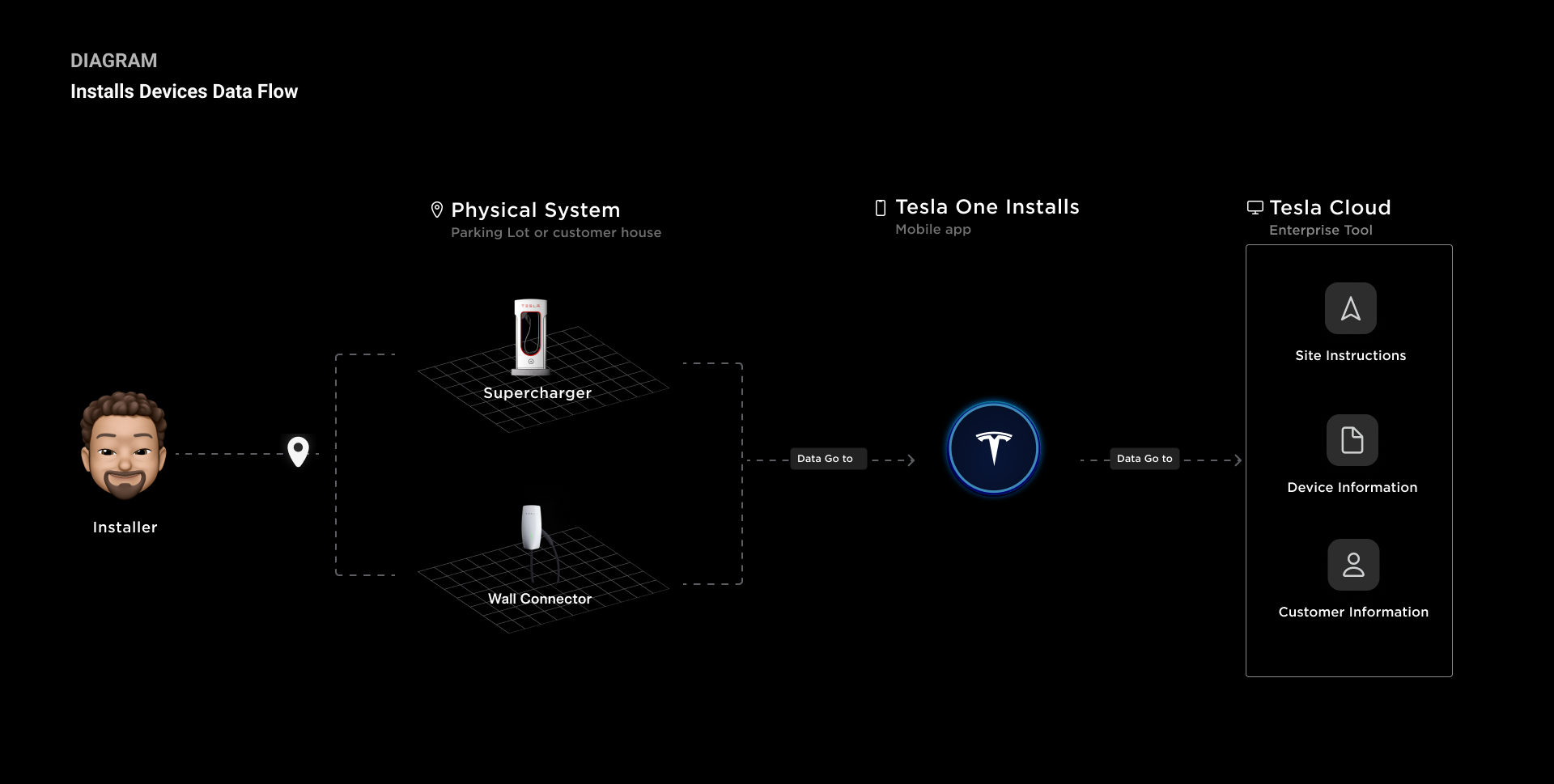
Installers work in large physical environments where charging posts, cabinets, and controllers are distributed across an entire site. Every action performed in Tesla One corresponds to a real-world device and contributes to a shared data system used for reporting, commissioning, and operational tracking.Understanding how physical work translates into digital workflows became critical to identifying the right design opportunities.
Problem
Framing
The Original Problem Was Too Narrow
The original problem from PM was straightforward:
Installers were spending too much time updating charging post coordinates inside Tesla One.
To locate a charging post, installers first had to switch to a third-party map tool such as Google Maps, estimate the physical location of the charger, copy the longitude and latitude coordinates, then return to Tesla One and manually paste the information back into the system. This process had to be repeated for every charging post on site, creating a repetitive and time-consuming workflow.
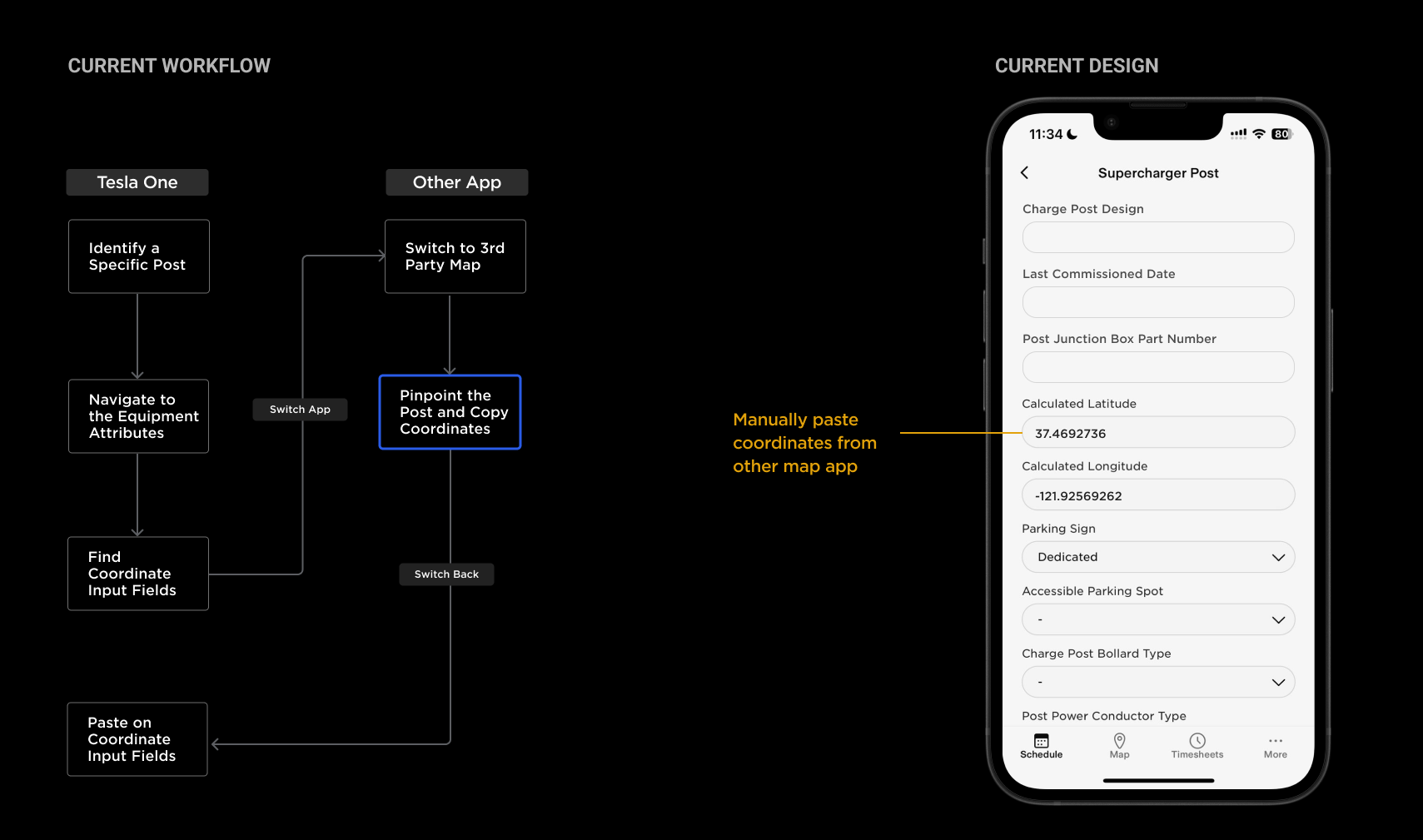
At first glance, the solution also seemed straightforward:
Embed a map API into the app so installers could update locations without switching to third-party tools.
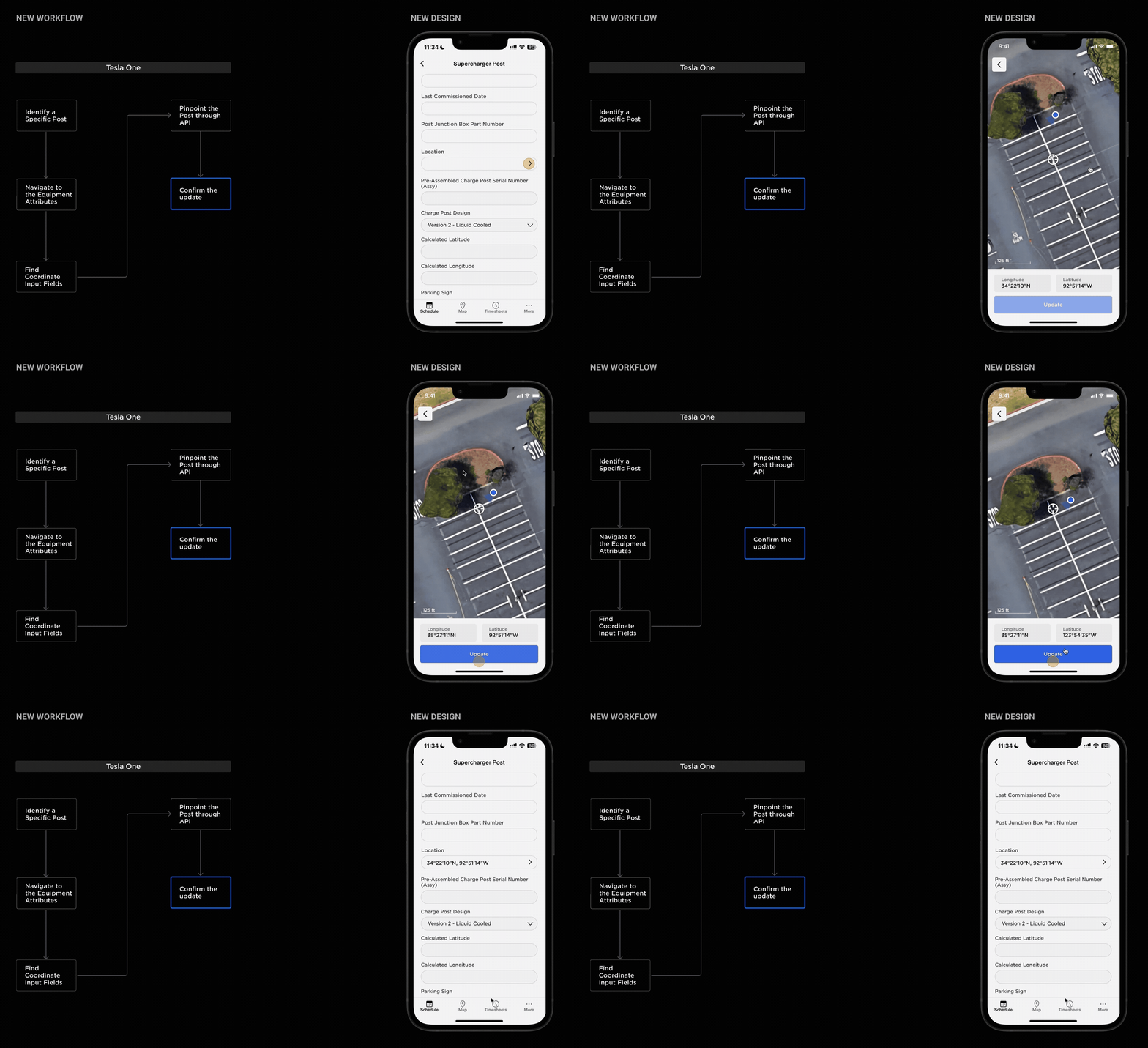
Knowing How to Solve It Was Not Enough
I quickly realized that knowing how to solve the immediate problem was not enough. The more important question was: Why did this problem matter in the first place?
Instead of immediately shipping the first solution, I stepped back to understand the broader operational context behind the request.
The Business Metrics Changed the Direction
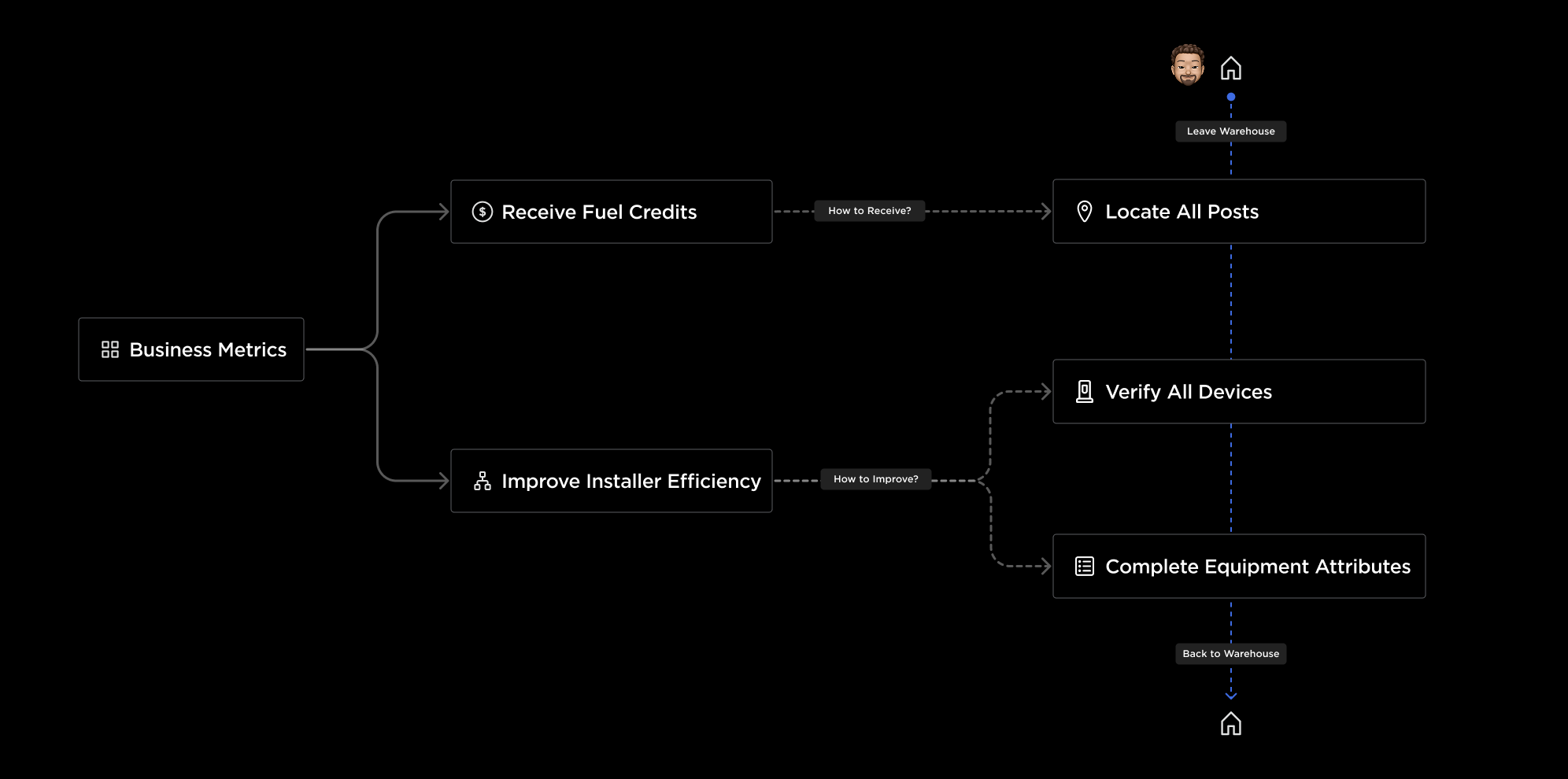
Through conversations with PMs and stakeholders, I learned that the workflow was tied to two important business metrics.
1. Tesla needed accurate charging location data to support fuel credit reporting (~$80 million per year).
2. Installer efficiency directly affected how quickly charging sites could be launched for public use and start generating revenue.
The project was no longer just about reducing app switching. It became a workflow problem tied to operational efficiency and business impact.
The Real Problem Was Bigger Than Location Updates
Once I understood the business context, I realized location updates were only one part of the installer’s daily workflow.Installers were responsible for much more than placing pins on a map.
Their workday included verifying physical devices, locating charging posts, completing equipment attributes, syncing operational data, and preparing charging sites for launch.
The real opportunity was not optimizing one interaction. It was redesigning the end-to-end installer journey.
Strategic Challenge
What Made This Project Hard
The hardest part of the project was not designing the workflow. It was deciding whether to optimize for speed or impact.
The original request focused on helping installers update charging post coordinates faster so Tesla could submit site information for fuel credit reporting. From a delivery perspective, the fastest path was to improve the existing workflow and ship as quickly as possible.
However, as I spent more time understanding the workflow, I realized the location update task was only one part of a larger operational process. Solving a single step would improve reporting speed, but it would leave many of the installer's daily inefficiencies unchanged.
Why Shipping Faster Was Not the Right Answer
At this point, the team faced a decision.
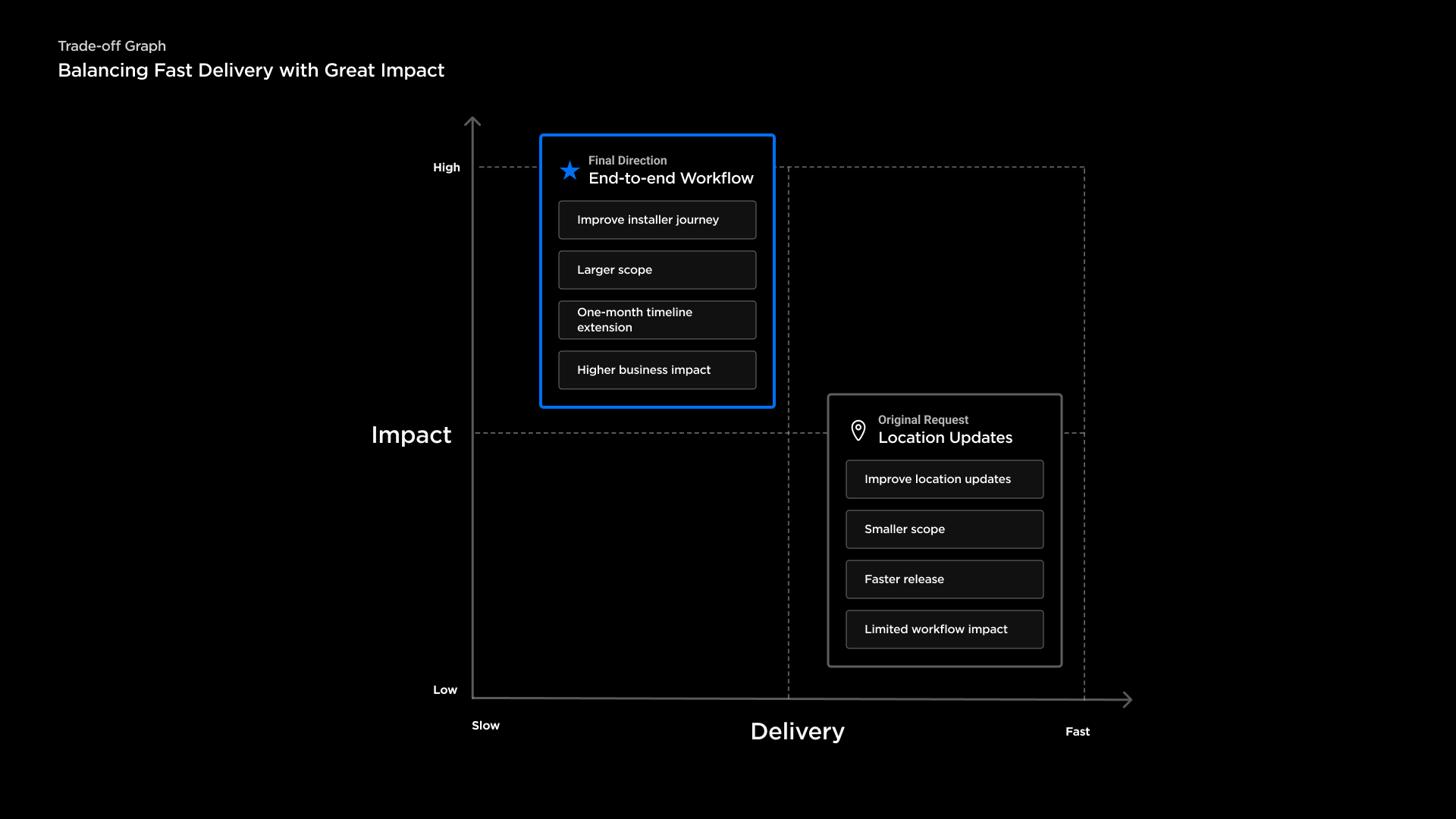
One option was to stay within the original scope, improve the location update experience, and deliver the project quickly. The other option was to step back and redesign the end-to-end installer workflow, including device verification, location updates, and equipment attribute completion.
While the first option reduced delivery risk, the second option addressed both business metrics: fuel credit reporting and installer efficiency.
The larger opportunity required more design and engineering effort, but it also had the potential to create significantly greater value for both installers and the business.
Why the Bigger Opportunity Won
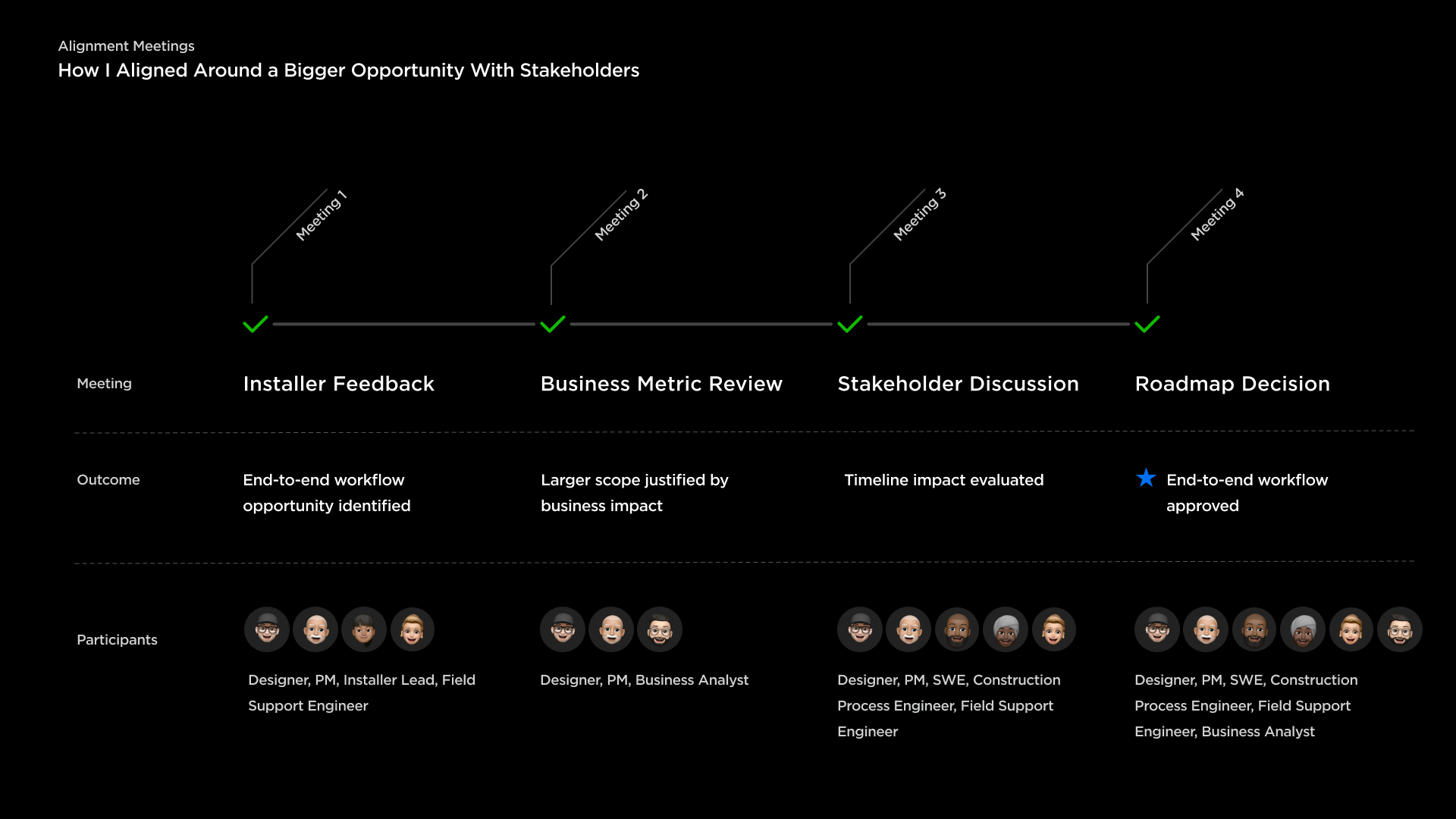
Rather than debating solutions, I focused the discussions around user value and business impact.
I worked with installer leads to validate whether the broader workflow opportunity reflected real operational challenges. I then aligned with business stakeholders to confirm that improving installer efficiency could generate a larger long-term impact than optimizing a single reporting task. Finally, I partnered with product managers and engineers to understand the delivery implications and identify a realistic timeline.
These conversations helped the team align around a shared conclusion: delaying the release by approximately one month was worthwhile if it allowed us to solve the larger workflow problem.
The project ultimately expanded from a location update feature into an end-to-end workflow redesign.
Design
Strategy
Understanding the Installer’s Physical Workday
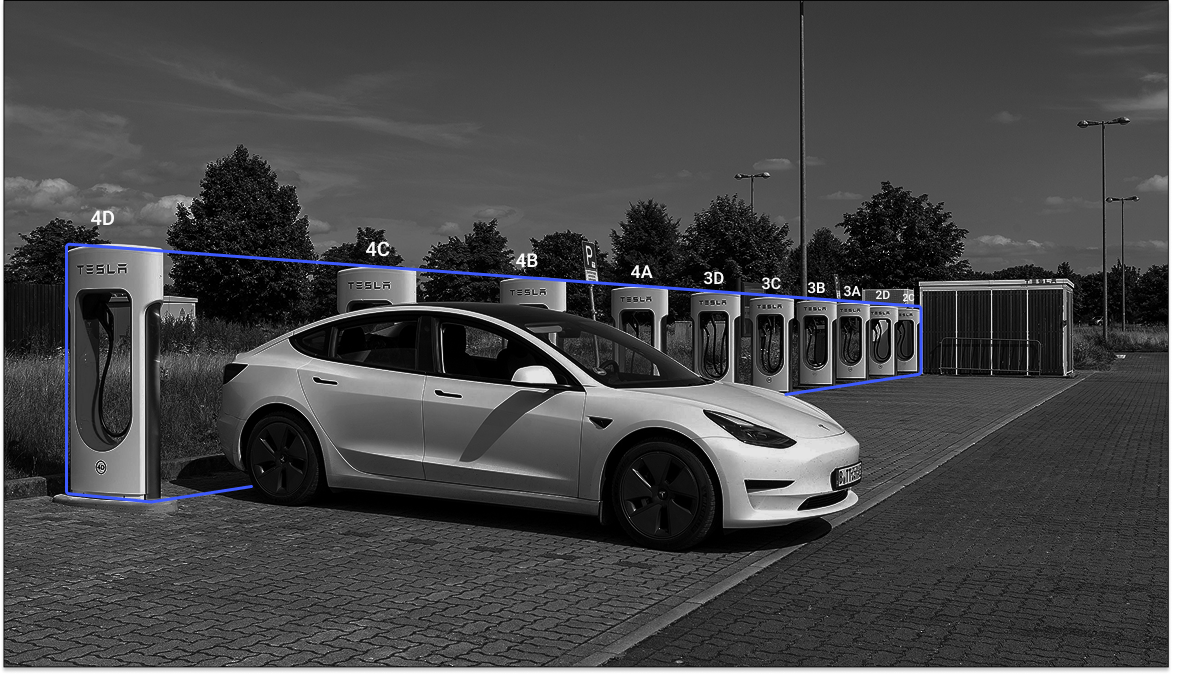
To better understand the installer workflow, I visited charging sites and observed how Superchargers were physically arranged in the environment.
I noticed that charging posts followed clear spatial patterns and naming sequences, such as 1A, 1B, 1C, and 1D.
Installers naturally move through sites in a continuous physical flow rather than interacting with each charger independently.
Understanding How the Digital Workflow Breaks Down
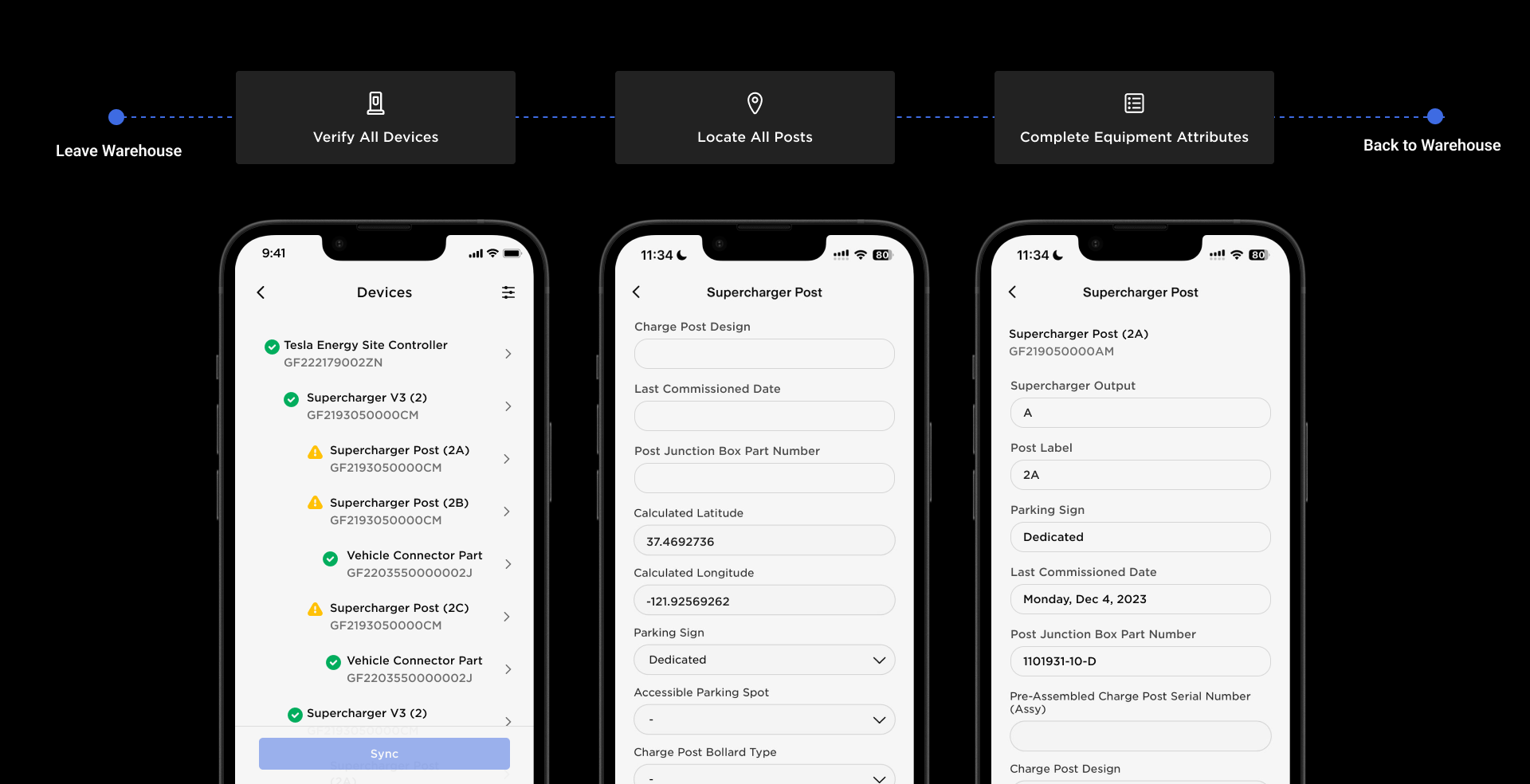
While the physical workflow is continuous, the digital workflow was fragmented across multiple tasks and screens.
I interviewed few installers and installer-facing stakeholders. The insights revealed repeated friction when verifying devices, locating charging posts, and completing equipment information.
Linking the Physical Workday to the Digital Journey
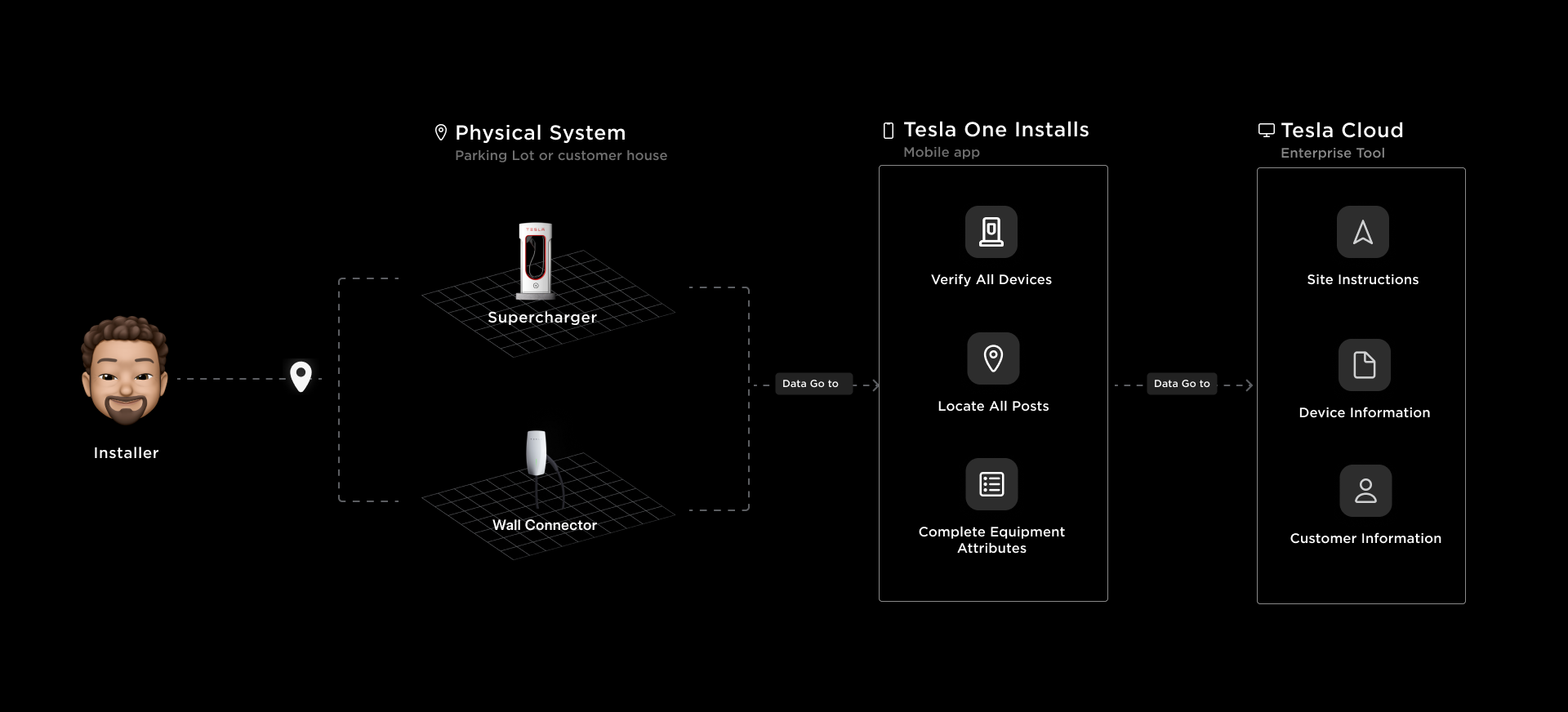
Currently, the physical workflow and digital app were entirely disconnected; installers navigated charging sites as a continuous operational process, while Tesla One treated tasks as isolated digital interactions.
By connecting physical operations, digital workflows, and business objectives, I identified three critical moments (verifying devices, locating charging posts, and completing equipment information) in the installer journey that represented the greatest opportunities for improvement.
Workflow
Redesign
I approached each opportunity as part of a larger workflow rather than as an isolated UI problem. Each solution was designed to reduce friction in the installer journey while supporting Tesla's broader business goals.
Workflow Moment 1: Verify Devices
Installer Problems
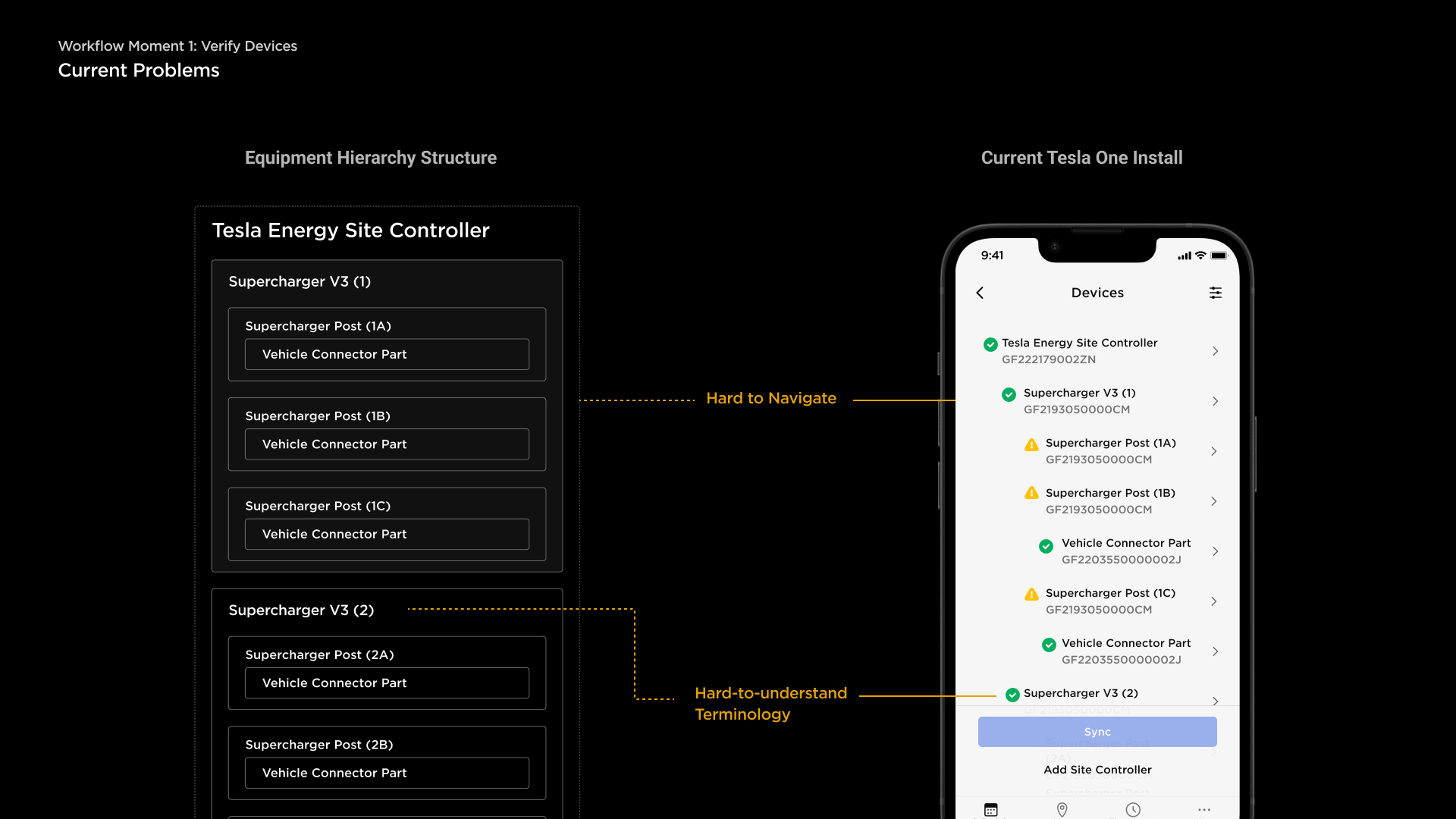
1. Installers found it difficult to quickly locate the device relationship they needed.
The Supercharger hierarchy was long and complex, so installers often had to scroll through multiple levels before finding the right relationship. For example, installer said, "Sometimes I need to scroll three to four times to find the relationship I want."
2. Installers also struggled when their field language did not match Tesla’s technical terminology.
For example, installer said, "I usually call Supercharger V3 as Cabinet 3." Installers naturally searched using the words they used on site, but the system was structured around Tesla’s technical naming convention.
Design Goal
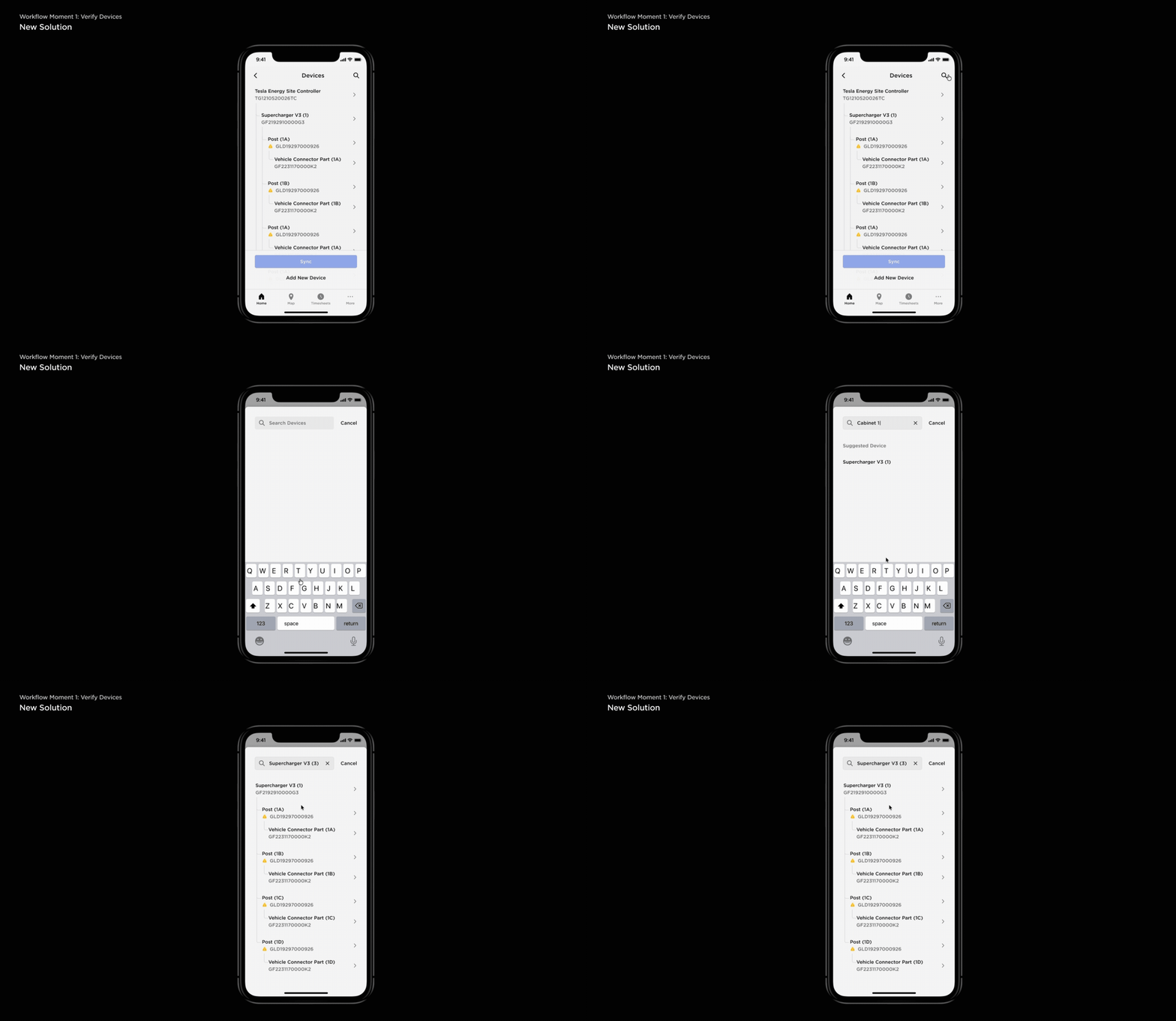
Enable installers to quickly find device relationships using familiar language and navigation patterns.
Design Solution
I added search directly into the hierarchy workflow and expanded search matching to recognize common installer terminology. For example, when installers searched “Cabinet 3,” the system could still surface the corresponding “Supercharger V3” device.This preserved Tesla’s technical structure while making the workflow easier for installers to use.
Workflow Moment 2: Locate Posts
Installer Problems
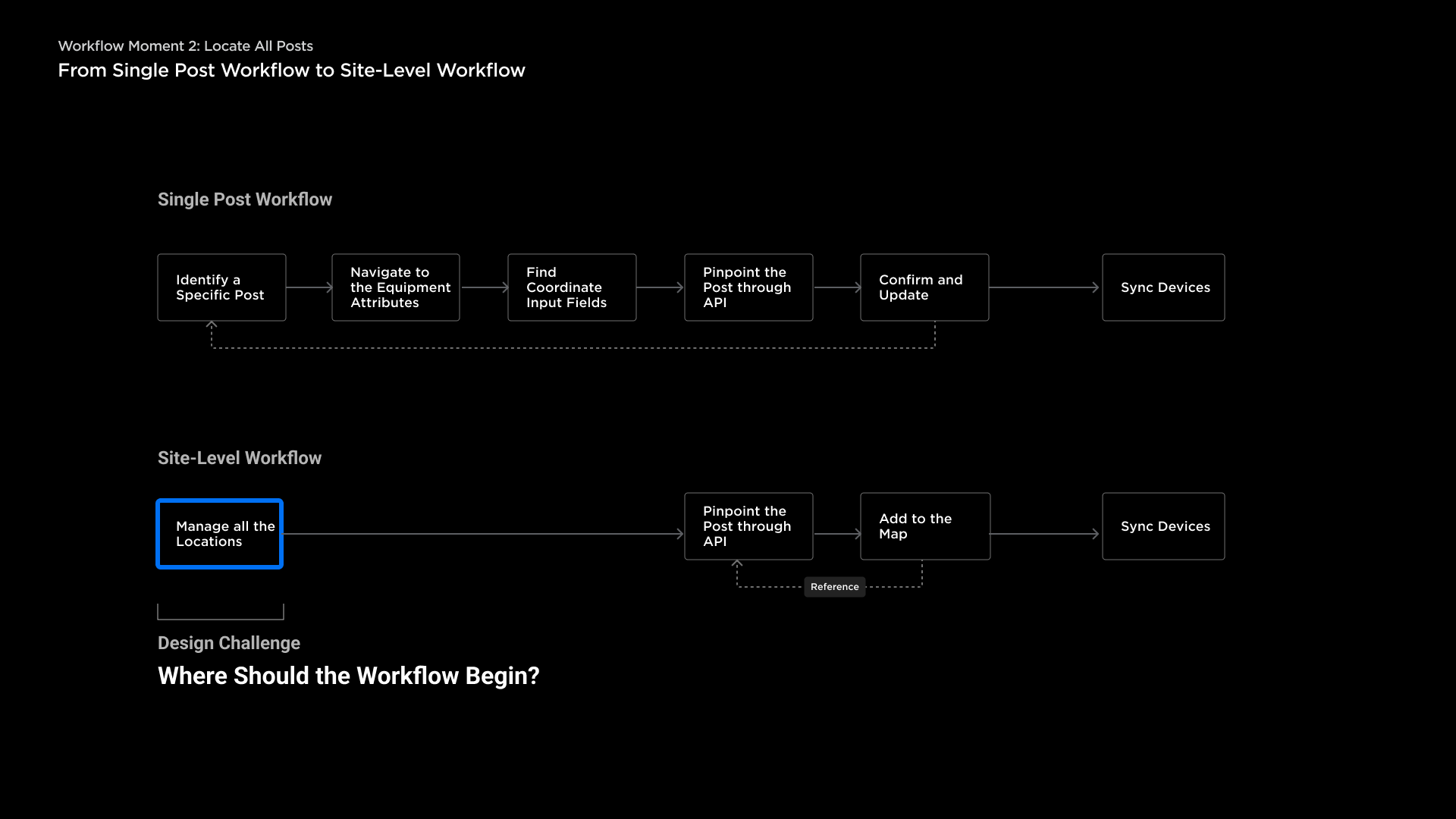
1. Installers found it time-consuming to update charging post locations one by one.
The original workflow was designed for a single-post task: select one post, open the map, update the location, return to the previous page, then repeat the same process for the next post. This created repetitive back-and-forth interactions across larger sites.
2. Installers also lacked visual reference for posts they had already added.
Because each map opened as a separate task, installers could not easily use the previous post as a reference point for the next one.
Design Goal
Enable installers to update all charging posts through a single continuous workflow.
Design Challenge
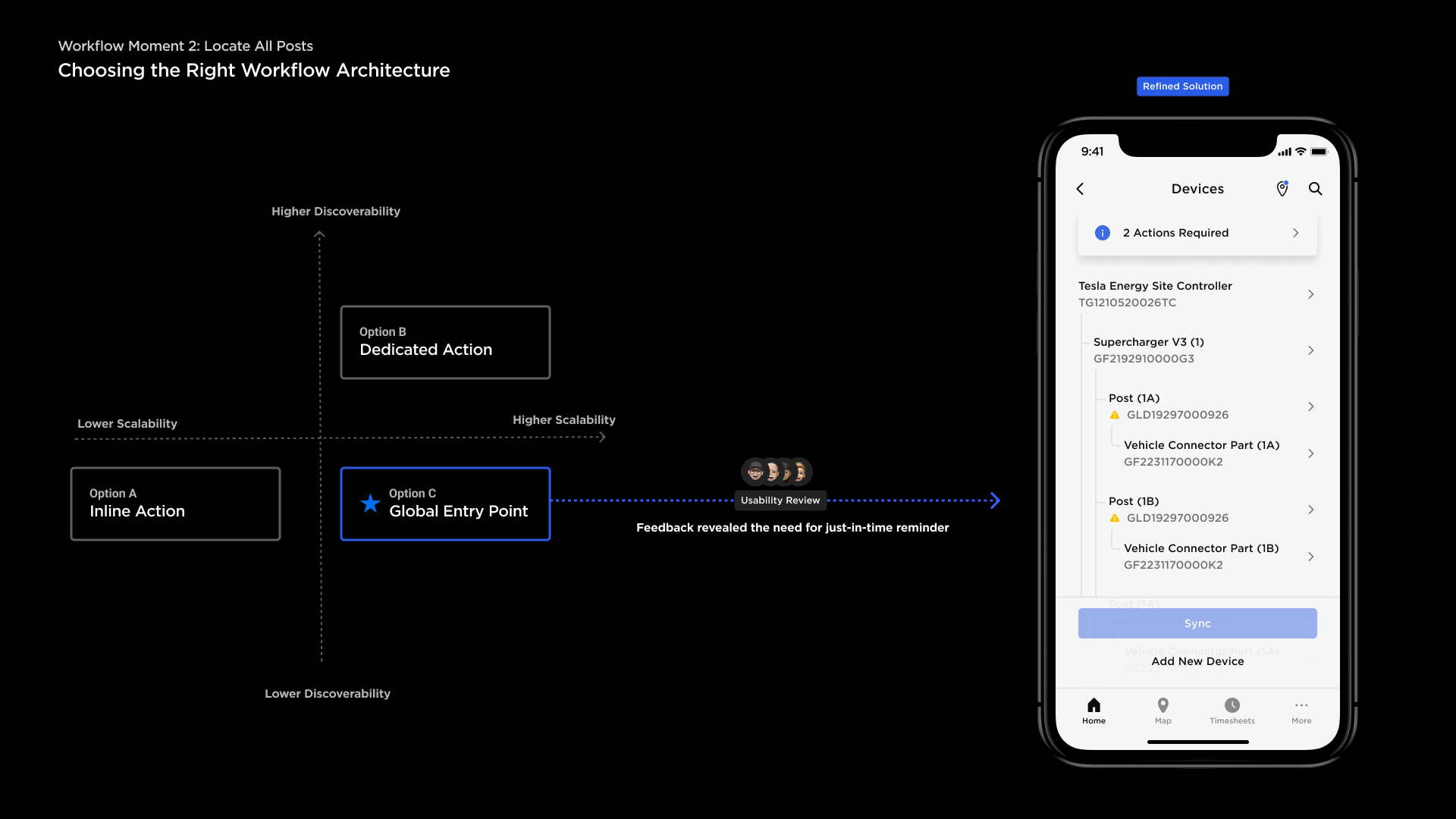
When the workflow expanded from managing a single post to managing an entire site, the original entry point no longer worked. The previous workflow was designed around updating one post at a time. However, the new workflow needed to support installers managing all posts within a charging site as a connected system. This raised a new design challenge: If installers are no longer working on a single post, where should the workflow begin?
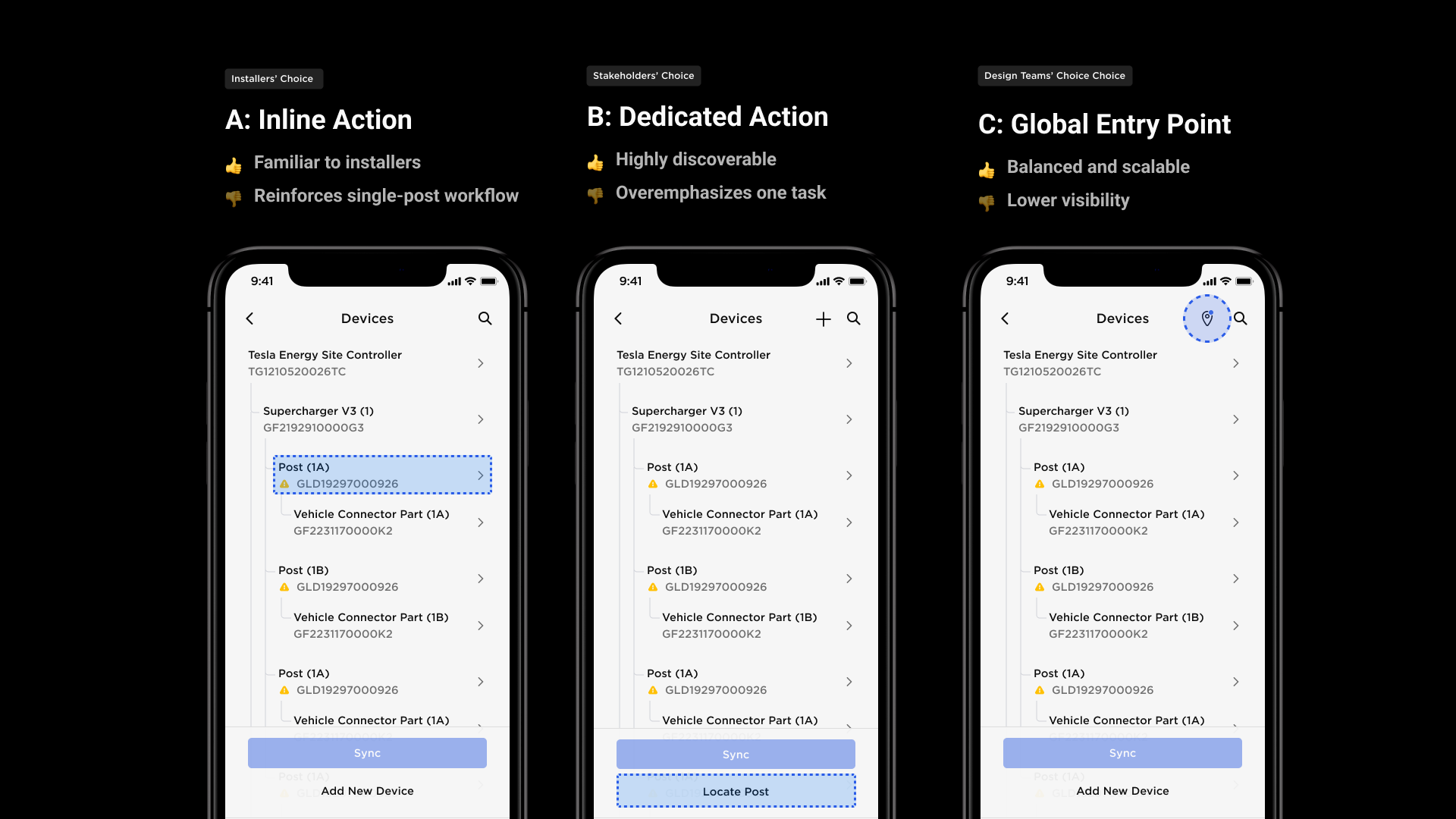
Option A: Keep location inside equipment attributes. This matched installers’ existing habits, but it made the workflow feel tied to one specific post.
Option B: Use a primary CTA for location updates. This made the task more visible, but gave too much weight to a temporary workflow.
Option C: Use a lighter entry point with contextual guidance. This balanced visibility with long-term scalability, but needed stronger guidance to help installers discover it.
Trade-off
Although Option C provided the most scalable workflow architecture, usability reviews revealed another issue. When installers were focused on verification and troubleshooting tasks, the location update action could still be overlooked. The workflow was available, but not always visible at the right moment.
Instead of introducing another entry point, I added a lightweight reminder layer that surfaced location-update tasks only when needed. This preserved the simplicity of the workflow while improving discoverability for first-time and infrequent users.
Final Solution
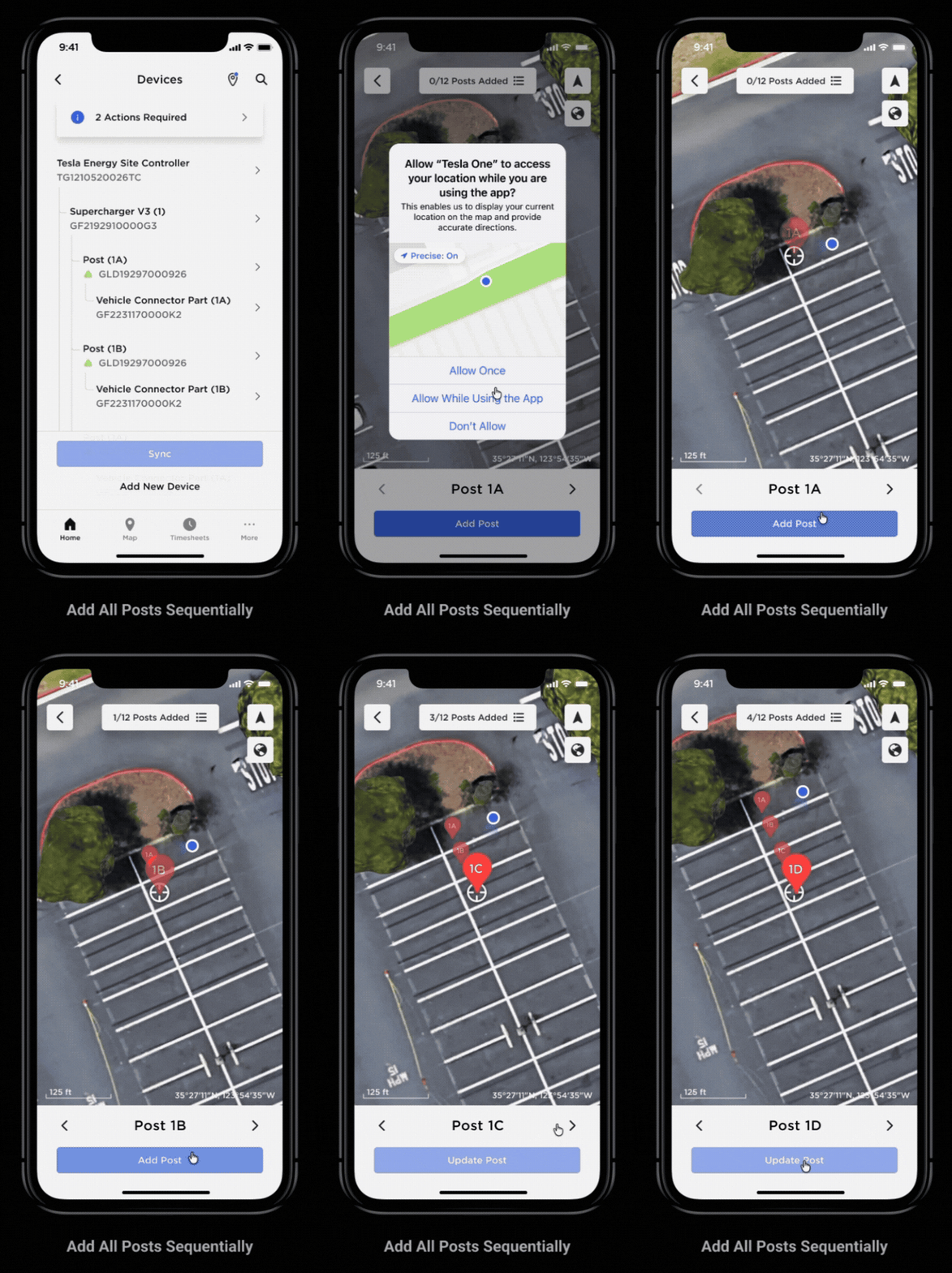
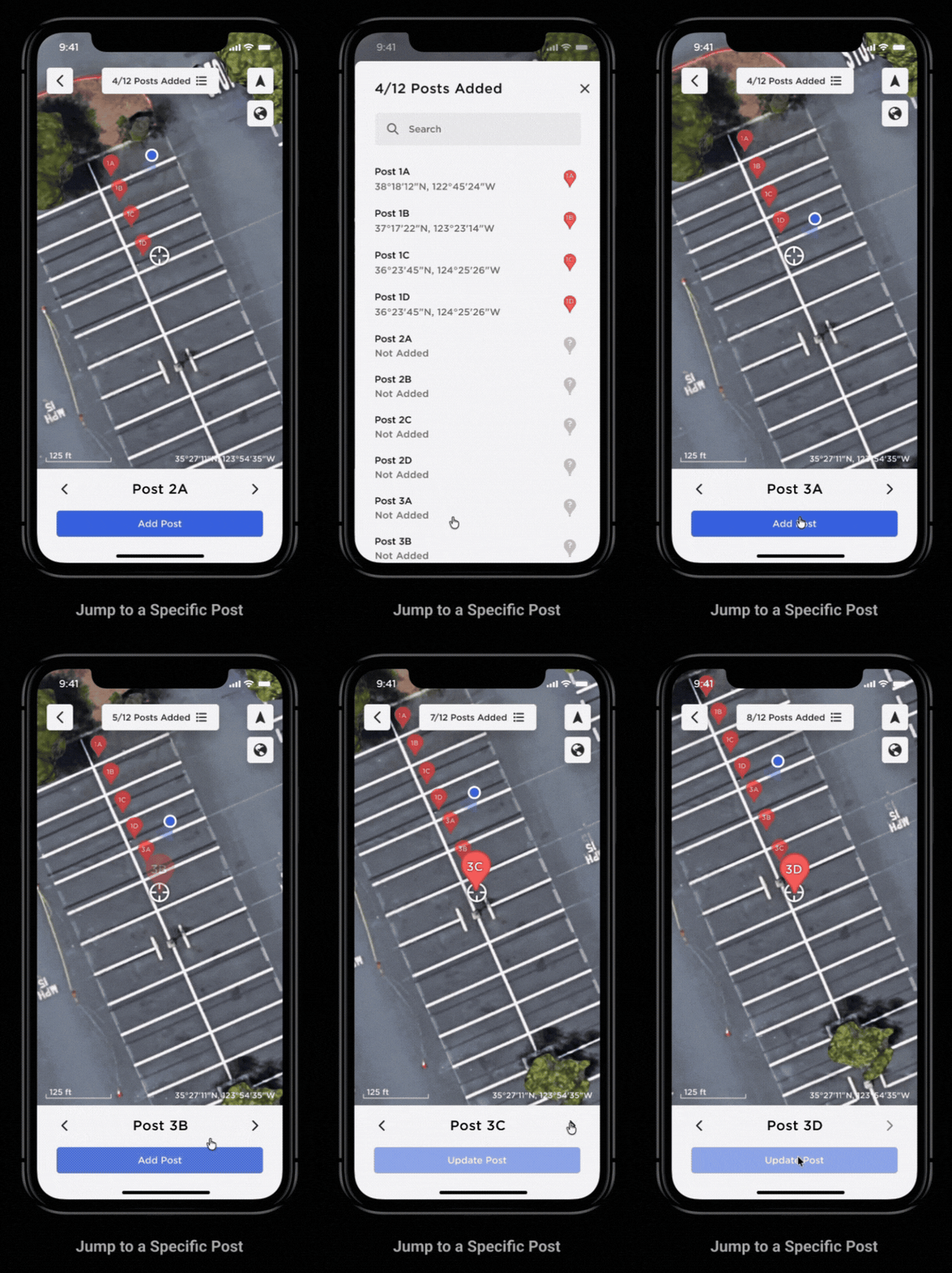
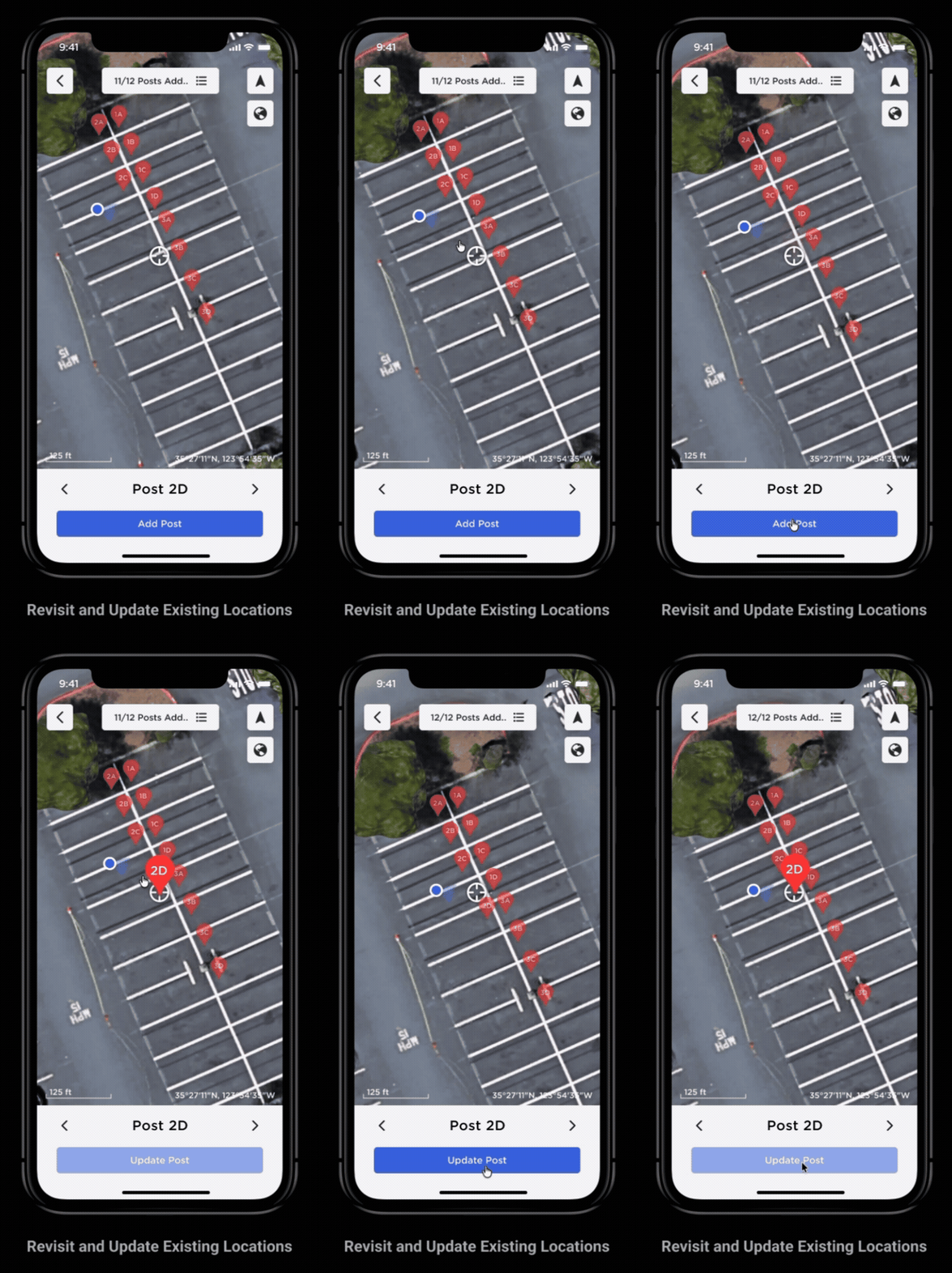
The final design introduced a site-level location management workflow that supports three common installer behaviors:
1. Add All Posts Sequentially: Installers can move through an entire charging site without repeatedly returning to the device list.
2. Jump to a Specific Post: Installers can directly navigate to a target post when working on non-linear site layouts.
3. Revisit and Update Existing Locations: Previously added locations remain accessible and editable throughout the workflow.
Workflow Moment 3: Complete Equipment Attributes
Installer Problem
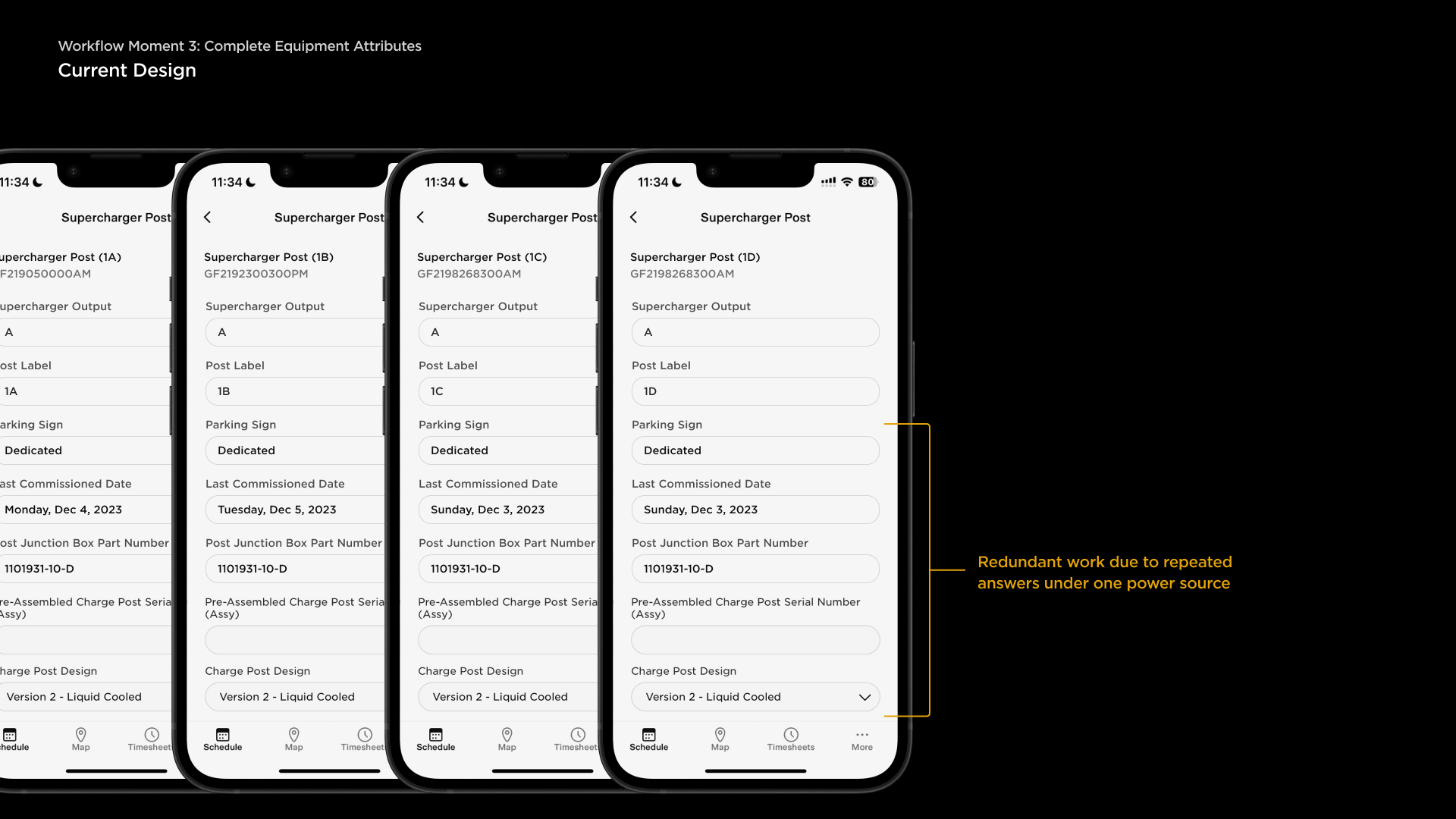
Installers found it time-consuming to complete equipment attributes because they repeatedly entered the same information across similar devices.
Many charging posts connected to the same power source shared common attributes. However, installers still had to fill out identical fields multiple times throughout the workflow.
Design Goal
Enable installers to complete once and apply across similar devices.
Understanding the Complexity
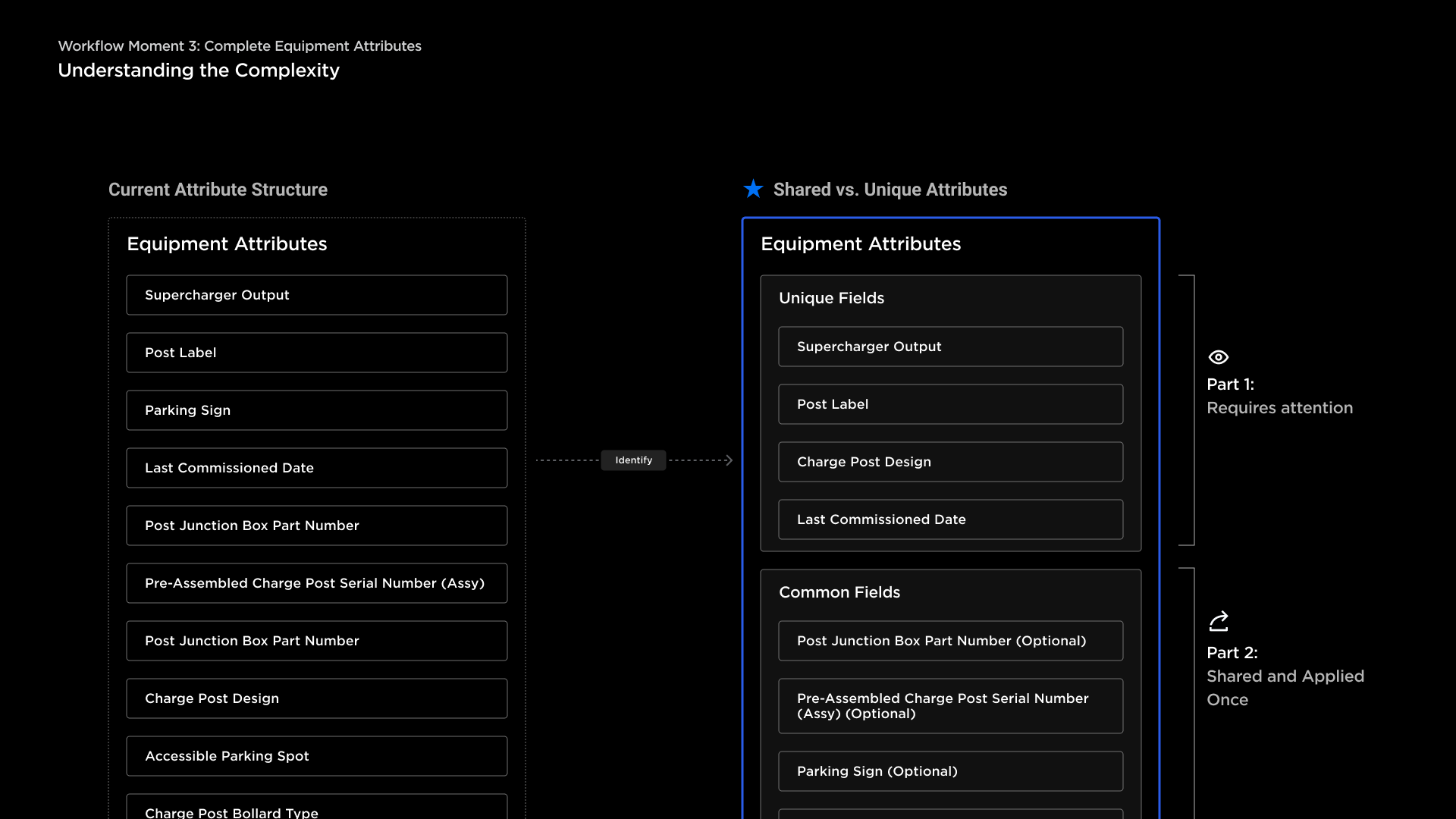
To simplify the workflow, I first mapped every equipment attribute and worked with field engineers to identify which fields were truly unique and which could be shared across devices.
This exercise revealed a clear separation between: Device-specific attributes & Site-level shared attributes.
Design Solution
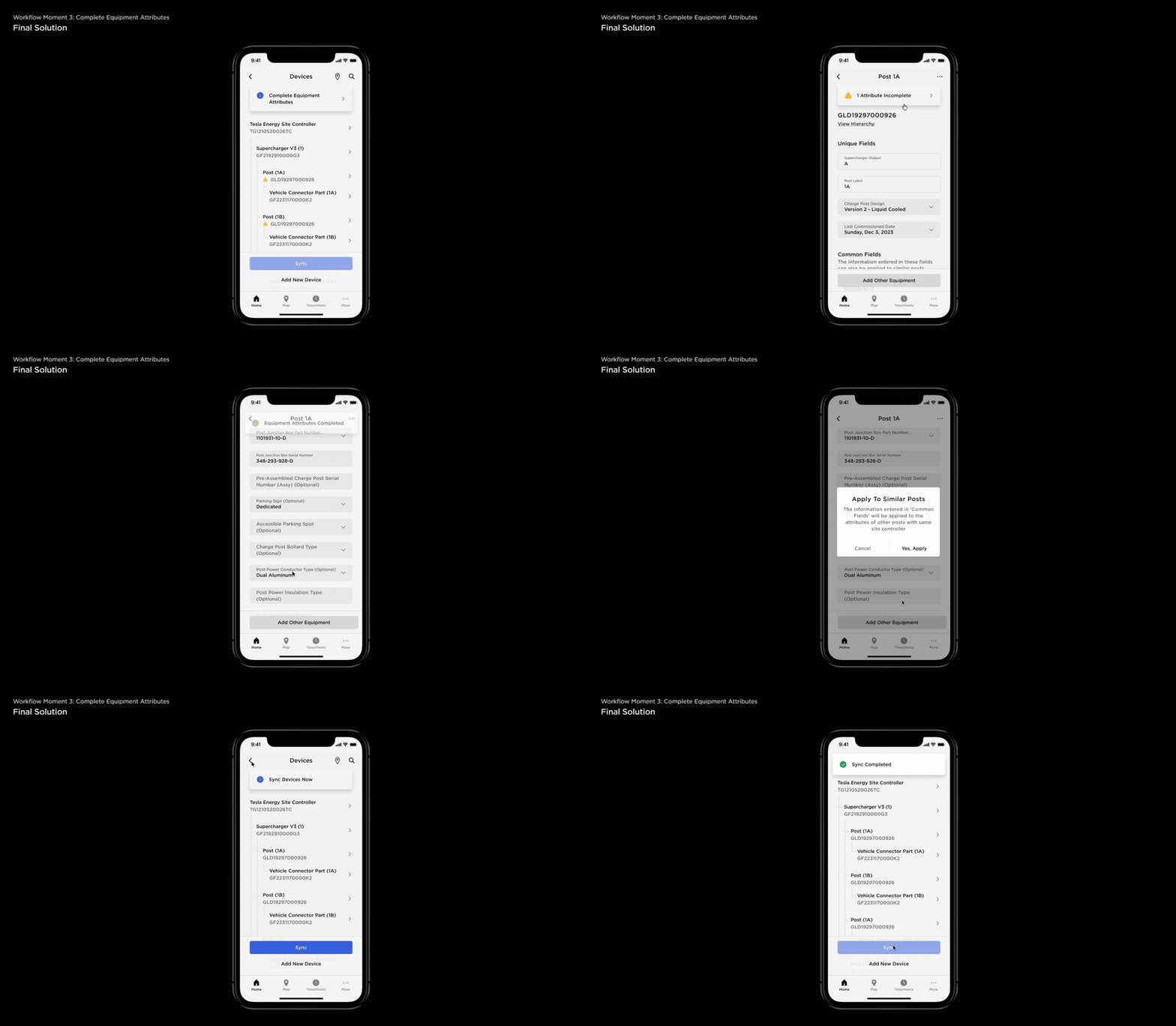
The final workflow separates unique fields from shared fields. Installers can complete shared attributes once and apply them across similar devices.
Measuring Success
$80M+ Annual Revenue Supported Through Fuel Credit Reporting
The redesigned workflow supported Tesla's Supercharger commissioning process, which plays a critical role in fuel credit reporting and compliance requirements. By improving how installers verify devices, locate charging posts, and complete equipment attributes, the project contributed to a workflow associated with more than $80 million in annual fuel credit revenue.
More importantly, the project expanded the original scope from a single-task optimization into an end-to-end installer workflow, creating value across multiple stages of site commissioning.
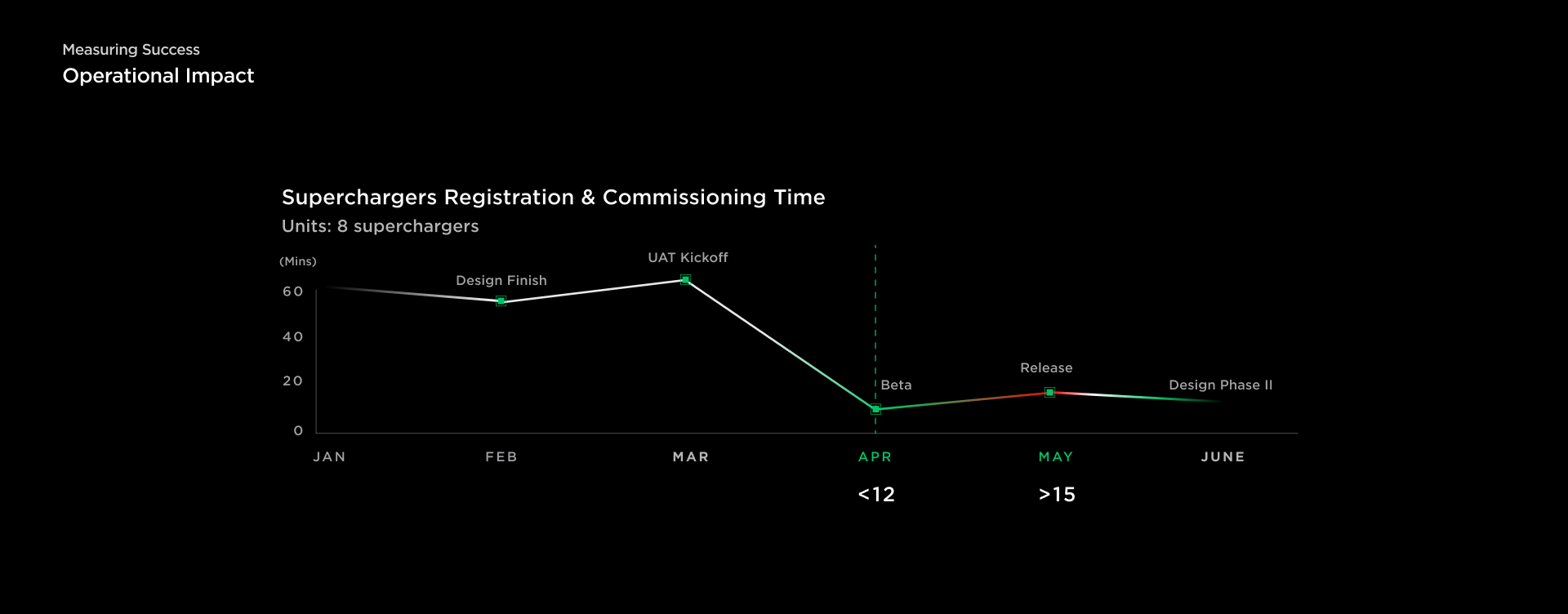
Reducing Equipment Entry from Hours to Minutes
The redesign reduced repetitive manual work across site commissioning workflows.
According to stakeholder estimates, commissioning a 40-post charging site previously required approximately five hours of manual equipment entry. By introducing shared attributes, site-level workflows, and streamlined location management, the process could be completed in less than one hour.
The workflow also shifted from managing individual charging posts to managing an entire charging site as a connected system.
Data Revealed the Next Opportunity
Although the workflow significantly reduced commissioning time after launch, the data revealed one remaining gap.
A small percentage of installers still missed follow-up actions required to complete site commissioning. The workflow itself had become faster, but visibility into unfinished tasks was still limited.
This insight led to the next iteration of the design, focused on helping installers identify outstanding actions before leaving the site.
Stakeholders Recognized the Value of the New Workflow
"This is super impactful for the Supercharger business. This workflow supports a revenue stream representing nearly 10% of our annual business."
— Ariel (Business Analyst)
"Interesting! This feels like a game."
"I really like the new design. It will be much easier for installers."
— Elaine (Field Support Engineer)
"For a 40-post site, manual equipment entry could take around five hours. With the new workflow, it takes less than one."
— Ravi (Construction Process Engineer)
Closing
Thoughts
1. Understanding why is more important than solving how.
The original request focused on updating charging post coordinates. By stepping back and understanding why the problem existed, the project uncovered a larger opportunity that extended beyond a single workflow and ultimately created greater user and business value.
2. Business metrics help prioritize design decisions.
Throughout the project, decisions were guided by two business metrics: fuel credit reporting and installer efficiency. These metrics helped align stakeholders, evaluate trade-offs, and focus the design effort on the opportunities with the highest impact.
3. Design is about how things work.
Launch was not the end of the project. Workflow metrics revealed new opportunities after release, helping define the next phase of improvements. Rather than treating design as a one-time delivery, the project demonstrated how continuous measurement can drive future iterations.
All rights reserved


